
Tuesday, 7 January 2025
Handout (2.0 MB)
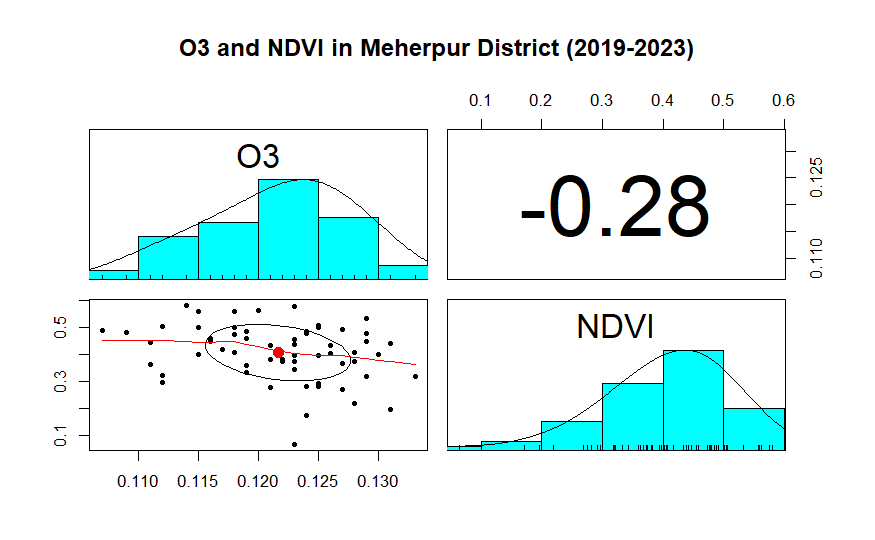
Ground-level ozone, a known carcinogen, threatens public health and regional food security by disrupting plant biological functions. Bangladesh, one of the least developed countries with 180 million people, ranks 8th globally in population density. Agriculture, contributing 41% to the labor force and 15% to GDP, faces chronic challenges from annual flooding, affecting 20-65% of the land. Additionally, worsening air pollution, especially ground-level ozone in western Bangladesh, further reduces crop yields, making the country the 3rd largest global food importer. This study aims to assess the relationship between the Normalized Difference Vegetation Index (NDVI) and tropospheric ozone concentrations to understand the impact of air pollution on vegetation health across five districts in Bangladesh. This study uses the NDVI, a remote sensing index for measuring vegetation health, and ground-level ozone, a pollutant that affects plant health and ecosystems. The relationship between the spatial distribution of NDVI and ground-level ozone was analyzed both qualitatively and quantitatively across five western districts of Bangladesh, where ground-level ozone shows the most significant interannual variability. Preliminary results show that areas with high ozone concentrations consistently align with low NDVI values, suggesting ozone damage to vegetation. A statistically significant negative correlation was found between NDVI and ground-level ozone across five districts in Bangladesh. Regions with the highest ozone levels had the lowest NDVI, and different crops exhibited varying sensitivities to ozone. The findings indicate that rising ozone levels negatively impact vegetation health and density. This study is significant for understanding how air pollution, specifically ground-level ozone, impacts ecosystems and agricultural productivity. Examining the relationship between ozone levels and vegetation health provides insights into the broader effects of air quality on food security and environmental sustainability in Bangladesh.
 - Indicates paper has been withdrawn from meeting
 - Indicates an Award Winner