
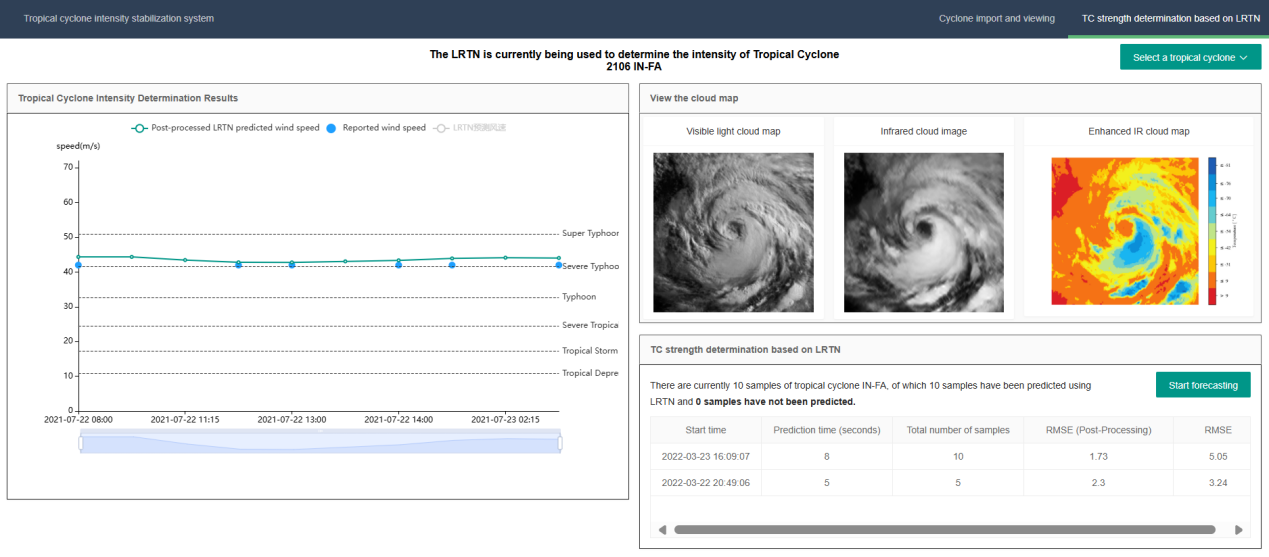
Tropical cyclones are among the most devastating natural disasters globally, causing severe economic losses to coastal regions, making their intensity estimation crucial for disaster prevention and mitigation. Traditional methods for tropical cyclone intensity estimation primarily rely on the empirical analysis of meteorological experts and limited observational data, which are often subjective and inefficient. In recent years, with the rapid development of satellite remote sensing technology, multispectral satellite cloud imagery has provided a rich data source for tropical cyclone intensity estimation. However, these data exhibit high-dimensional characteristics, and effectively extracting key features from them to achieve accurate intensity estimation has become a significant challenge in the meteorological field. Deep learning methods for analyzing multispectral imagery can improve the accuracy of tropical cyclone intensity prediction. Although existing deep learning-based intensity estimation models have made some progress, their complex model construction and training processes make them difficult for meteorological experts to use directly. Currently, there are few application developments based on deep learning intensity estimation models, and publicly available systems lack strong human-computer interaction. Moreover, they do not fully utilize China's satellite data, limiting their application in practical operations. To address these issues, this paper proposes an innovative Low-Rank Tensor Network (LRTN) model, aiming to leverage the low-rank characteristics of multispectral satellite cloud imagery to enhance the accuracy of tropical cyclone intensity estimation. The LRTN model consists of multiple Spatial-Spectral Feature Representation (SSFR) modules, combining tensor decomposition with convolutional and pooling operations to simultaneously extract physically meaningful spatial features and low-rank spectral features. Experimental results show that the LRTN achieves a wind speed estimation error of only 3.99 m/s on the FY4A-TC dataset, significantly outperforming existing methods, demonstrating its effectiveness in tropical cyclone intensity estimation tasks. To apply the LRTN model to practical meteorological operations, this paper also develops a tropical cyclone intensity estimation system based on FY-4 satellite cloud imagery. The system provides a user-friendly web interface, enabling meteorological experts to conveniently invoke deep learning models for tropical cyclone intensity estimation. The system integrates the LRTN model and is suitable for both labeled and unlabeled data requirements. Testing shows that the system operates stably and performs well, effectively meeting the application needs of meteorological experts for deep learning-based intensity estimation models. The main contributions of this paper include: proposing an innovative Low-Rank Tensor Network (LRTN) model that significantly improves the accuracy of tropical cyclone intensity estimation through multi-level low-rank feature extraction and optimization techniques; developing a web-based tropical cyclone intensity estimation system that combines deep learning models with practical operational needs, providing convenient human-computer interaction. The successful application of this system not only offers a new technical approach for tropical cyclone intensity estimation but also provides an important reference for the promotion and application of deep learning models in the meteorological field, with broad application value and social significance.
 - Indicates paper has been withdrawn from meeting
 - Indicates an Award Winner