
Handout (288.6 kB)
In detail: Schwarzschild’s (1906) two-stream approximation gives the following terms for A (upward beam), B (downward beam), E (black-body emission of a layer) and A0 (representing both absorbed solar and emitted longwave radiation at the top-of-atmosphere):
E = A0(1+m)/2; A = A0(2+m)/2; B = A0m/2, (Schwarzschild 1906, Eq. 11)
where m is ‘Optische masse’, the optical depth. In Emden's treatment, m is the physical mass, k the absorption coefficient:
B = –kγm+B0; A = –kγm+A0; E = –kγm+E0. (Emden 1913, Eq. 31)
with
γ = (B0 – A0)/2, E0 = (B0 + A0)/2. (Emden 1913, Eq. 32),
stating that this approach and solution are given by Schwarzschild (1906). But while in Schwarzschild it is evident for the first sight that A – E = A0/2, it is less obvious in Emden’s formulation — and even less clear in the English translation.
In the latter, the case is complicated further by the Translator’s footnotes (6) and (7), comparing Emden’s method to that of Gold (1909, Proc. Royal Soc.), emphasizing the differences, and thereby suggesting that Emden’s work is based on Gold’s; while in reality Emden’s method (and the two features mentioned) is the same as in Schwarzschild’s. This way, the attention of the Reader is further distracted away from looking at the original Schwarzschild paper. As a final outcome, the Manabe and Möller (1961, MWR) paper does not refer to Schwarzschild, but only to Gold and Emden, and does not include the explicit formula for the net radiation at the surface (connecting it to half of OLR)—and neither of its follow-ups (Manabe and Strickler 1964, Manabe and Wetherald 1967). For example, the latter two compute correctly the size (magnitude) of the temperature jump at the surface (Fig. 4, and Fig. 5., respectively), but the constraint on it – that it equals half of the effective emission – is never mentioned.
But it is there, explicitly, in handbooks like Goody (1964, Eq. 2.115); Houghton (1977, Eq. 2.13); Chamberlain (1978, Eq. 1.2.29 and Fig. 1.4); Goody and Yung (1989, Eq. 2.146); Salby (1996, Eq. 8.67); Visconti (2001, Eq. 3.49); Pierrehumbert (2008, Eq. 4.45); Vardavas and Taylor (2007); Andrews (2010); Ambaum (2021, Eq. 10.56), etc.
The question is, is it true in observations? When we first encountered this question, CERES EBAF Edition 2.8 was available, and we took the data from a presentation of F. Rose (2017) on a science team meeting at Langley; global means (March 2000 - February 2016). Let’s have
RN = Net radiation at the surface = SFC (SW net + LW net) = SFC (SW down – SW up + LW down – LW up) = TOA LW up/2 , true or not?
Data from Rose et al. (2017), clear-sky:
RN = 244.06 – 29.74 + 316.27 – 398.40 = 132.19 Wm-2.
TOA LW up = 265.59 Wm-2; TOA LW up /2 = 132.795 Wm-2.
Yes, RN = TOA LW up/2 – 0.60 Wm-2. Notice, Earth’ heat uptake was 0.58±0.38 Wm-2 at that time (Loeb et al. 2012).
The equivalence of RN = A – E = A0/2 triggers another question: how much are A and E, separately? As the TOA is defined at the optical depth m = 0, and OLR is released at m = 1, let’s try the surface with m = 2. Substituting it to Schwarzschild (1906, Eq. 11), we get A = 2A0 and E = 3A0/2. Using the same dataset, the total absorbed radiation at the surface
RT = A = SFC (SW net + LW down) = 244.06 – 29.74 + 316.27 = 530.59 Wm-2; 2A0 = 2 × 265.59 = 531.18 Wm-2; the difference is – 0.59 Wm-2.
Further,
RT – RN = E = 398.40; 3A0/2 = 398.385 Wm-2, the difference is 0.015 Wm-2.
These were for clear-sky. To create their all-sky versions is easy, by separating atmospheric LW radiation transfer from the LW effect of clouds. Hence, with all-sky data at both sides,
RN (all-sky) = SFC (SW net + LW net) (all-sky) = (TOA LW up – LWCRE)/2, and
RT (all-sky) = SFC (SW net + LW down) (all-sky) = 2 x TOA LW up (all-sky) + LWCRE.
Using the most recent, completed and archived CERES EBAF Edition 4.1 data product covering 264 monthly global means from April 2000 through March 2022, the differences of the individual equations are: -2.33; -2.82; 2.71; and 2.44 Wm-2, respectively, and the mean bias of the four equations, using four decimal places from the netCDF file is 0.0007 Wm-2, see Table 1. (Data were obtained from the NASA LaRC CERES ordering tool at https://ceres.larc.nasa.gov/data)
Further readings:
Zagoni, M. (2024): Trenberth’s (2022) Greenhouse Geometry. EGU General Assembly 2024, Vienna, Austria, 14–19 Apr 2024, EGU24-7,
https://doi.org/10.5194/egusphere-egu24-7 and the Supplementary Material:
https://www.earthenergyflows.com/Zagoni-EGU2024-Trenberths-Greenhouse-Geometry_Full-v03-480.mp4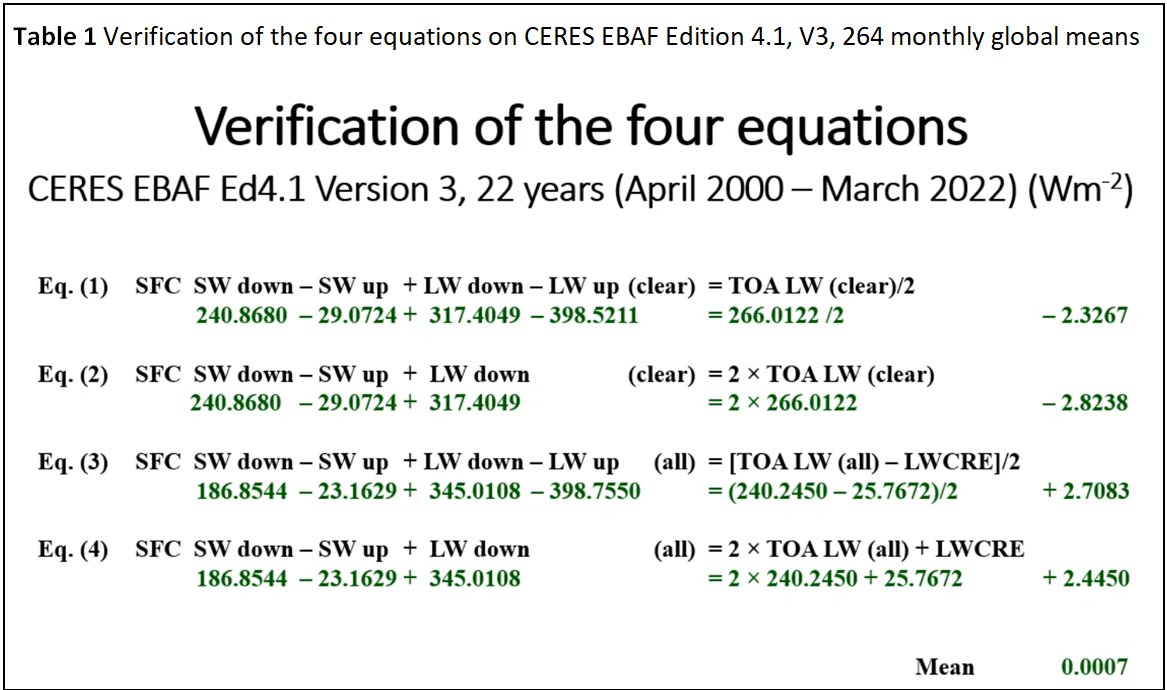
Supplementary URL: https://agu24.ipostersessions.com/default.aspx?s=68-C6-67-87-C2-9A-1F-66-64-57-17-86-DA-0F-9D-DC&guestview=true
 - Indicates paper has been withdrawn from meeting
 - Indicates an Award Winner