
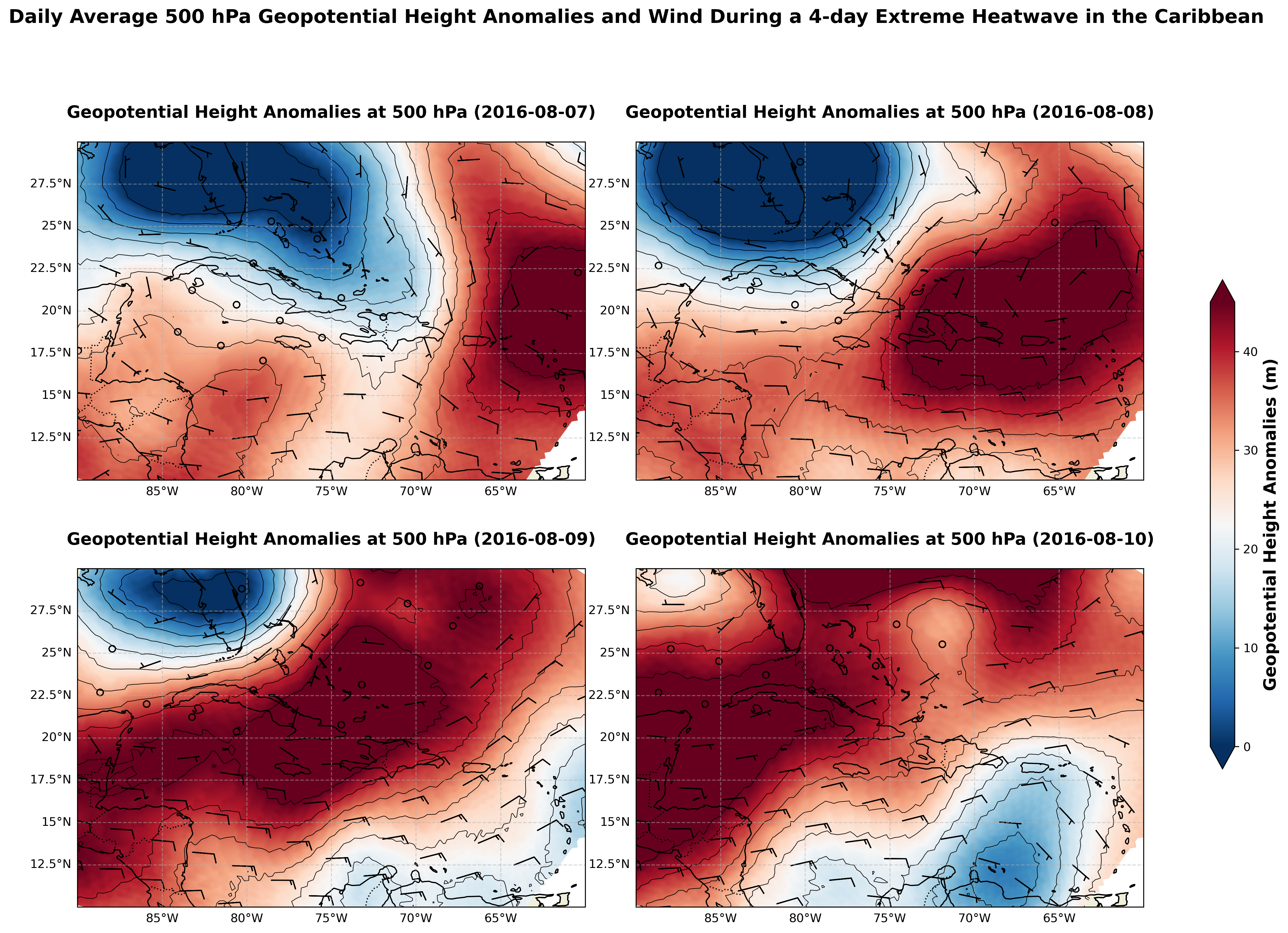
Extreme heatwaves pose a significant threat to human health, especially in tropical regions such as the Caribbean, where ambient temperatures are inherently elevated. The accelerated warming of sea surface temperatures in this region, driven by global climate change, has further exacerbated the situation by increasing humidity levels. This combination of high temperatures and humidity intensifies the physiological stress on populations, making the impacts of extreme heatwaves particularly severe in these areas. This study investigates the characteristics and drivers of heatwaves within the Caribbean from 1971 to 2020, with a focus on understanding synoptic drivers of heatwaves and enhancement by the El Niño–Southern Oscillation (ENSO) during summer months (June-August). In this study, we define an extreme heatwave as an event characterized by at least two consecutive days during which both the daily maximum and minimum heat index simultaneously exceed the 95th percentile for each calendar day. This criterion is chosen to reflect conditions of minimal nocturnal cooling, which are associated with significantly heightened risks to human health. Additionally, a heatwave is defined as an event where only the daily maximum heat index exceeds the 95th percentile threshold. Given the profound implications for public health, our analysis places greater emphasis on extreme heatwave events. We utilized data from the European Centre for Medium-Range Weather Forecasts Reanalysis 5 (ERA-5) at 9 km resolution and NCEP North American Regional Reanalysis (NARR), approximately 32 km resolution. Our analyses utilize several heatwave metrics such as: heatwave events per year, most prolonged heatwave of the year, cumulative heatwave days annually, and others for the Caribbean region. Trend and spatial analyses of these heatwave metrics over the 50-year period identified significant patterns in heatwave characteristics, and regions within the Caribbean that are particularly susceptible to extreme heatwaves. Trends in the number of participating heatwave days show an average increase of 3 days per decade, with spatial variability ranging from 0.96 to 6.04 days per decade. Cities such as Havana (6 days/decade) and Port-au-Prince (4 days/decade) are hotspots for rising heatwave activity, with significant increases also seen in Kingston and Cancun (both 3 days/decade) and (1.5 days/decade) for San Juan, Santo Domingo and Managua. In contrast, the increase in extreme heatwave days is modest, averaging 1.5 days per decade, with variability from 0.5 to 2.5 days per decade. This slower rise in extreme heatwave days reflects the effect of night cooling in the Caribbean, where steady trade winds typically lower night temperatures, reducing the occurrence of heat events that persist both day and night. However, when night cooling is reduced, the risk to human health increases sharply, particularly in urban areas. To assess the influence of large-scale climatic phenomena drivers, we analyzed the correlation between Caribbean heatwave characteristics and ENSO events. Preliminary results indicate statistically significant correlations between strong El Niño events and increased heatwave counts, while weak El Niño events tend to show a mitigating effect on heatwave frequency and severity. Further analysis includes a composite of atmospheric conditions, before, during and after identified extreme heatwave events to understand the synoptic and dynamic drivers. These analyses reveal that these events are driven by the persistence of an upper-level ridge, characterized by strong positive 500mb geopotential height anomalies, positive 500mb omega anomalies, and weak wind patterns, leading to adiabatic warming and cloud suppression, especially during El-Nino summers. This process allows for increased solar radiation at the surface and maintains clear skies, intensifying heat conditions. The stationary or slow-moving ridge also limits moisture transport, intensifying heatwave. Although heatwaves are challenging to predict beyond weeks, the strong correlation between El Niño intensities and increased heatwave frequency in the Caribbean offers a valuable predictive tool. Monitoring El Niño events and intensities can provide advanced warnings of heightened heatwave risks, allowing for improved preparedness and adaptation strategies. This research contributes to the broader understanding of extreme weather events in the context of a changing climate and aims to inform mitigation and adaptation strategies to protect vulnerable communities in the Caribbean.
Keywords: Heatwaves, Caribbean, El Niño, La Niña, Climate Change, Heat Index, Climate Extremes
 - Indicates paper has been withdrawn from meeting
 - Indicates an Award Winner