
Monday, 13 January 2025
Hall C (New Orleans Ernest N. Morial Convention Center)
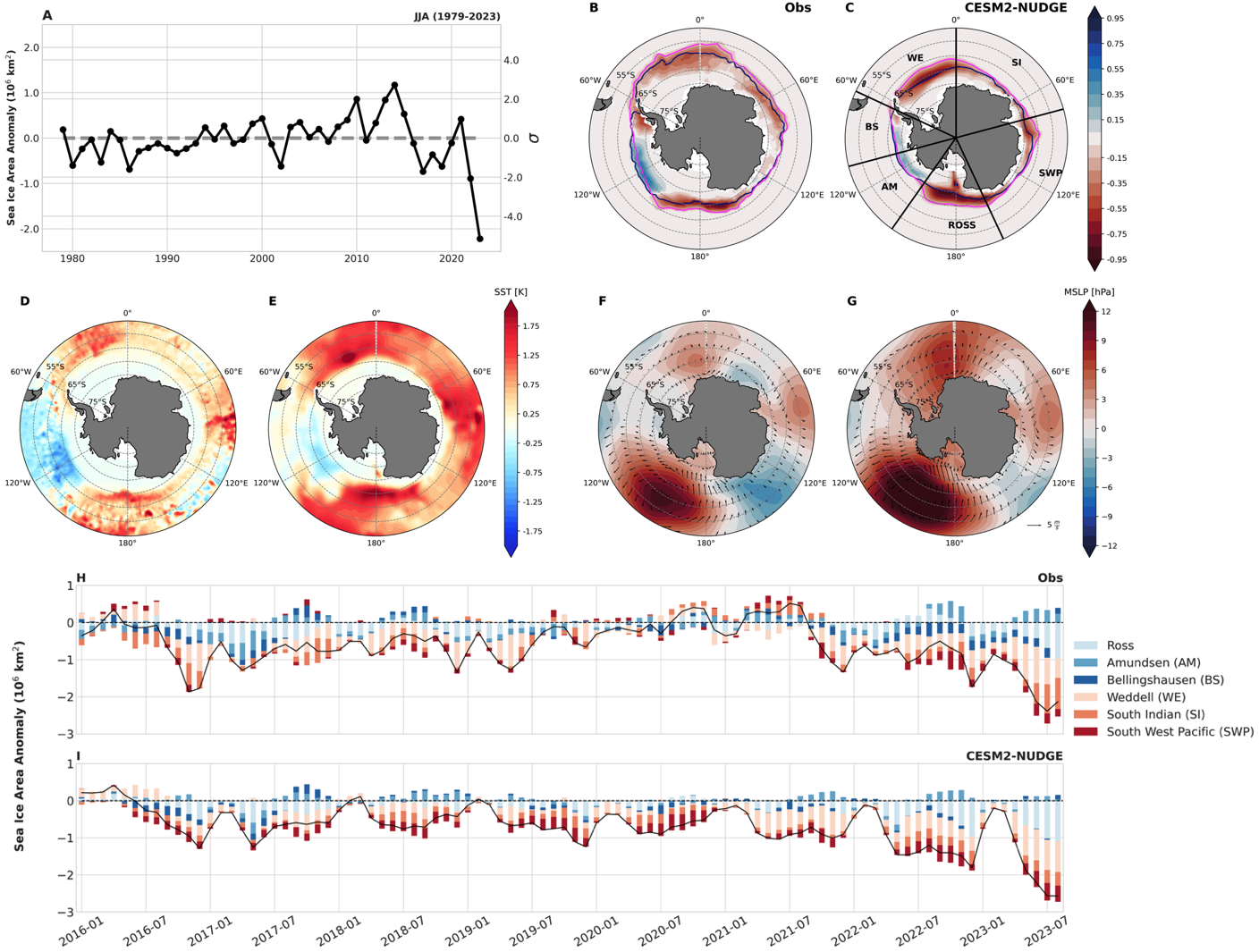
Since the start of the satellite record in 1979, the three lowest summertime minimums in Antarctic sea ice area (SIA) occurred in 2017, 2022, and 2023. These extremes - all within the last seven years - culminated in a record low SIA anomaly in austral winter 2023. During this period SIA was over 2 million km^2 below climatology, an anomaly of over 5 sigma units and .9 million km^2 lower than the previous largest negative seasonal SIA anomaly. We show that a fully-coupled Earth System Model run with historic and anthropogenic forcing and nudged to observed winds over 1950-2023 reproduces the observed austral winter 2023 SIC anomalies. We show that the 2023 transition from La Niña to El Niño had minimal impact. Using an ensemble initialized on January 1st 2023 nudged to past years' winds, we demonstrate that ~70% of the total Antarctic SIA anomaly was predictable six months in advance and driven by warm Southern Ocean sea surface temperatures that developed prior to 2023, with the remaining ~30% attributable to 2023 atmospheric circulation. An ensemble forecast suggests that Antarctic SIA is likely to remain significantly below climatology in austral winter 2024 due to continuing warm Southern Ocean conditions.
 - Indicates paper has been withdrawn from meeting
 - Indicates an Award Winner