
Ensemble consensus products have been developed that include an ensemble mean, a probability matched (PM) mean, localized probability matched (LPM) mean, and Spatially Aligned Mean (SAM) products. The SAM technique attempts to preserve the structure and local maxima from individual CAM members by locally adjusting precipitation fields to a common location. LPM can be applied to the re-aligned members so SAM products include both SAM and SAM followed by LPM (SAM-LPM).
Beginning in 2022, CAPS produced artificial intelligence machine learning (ML) products to predict rainfall, using a U-Net deep learning approach to forecast the probability of rainfall exceeding 0.5 and 1.0 inches during 6-hour periods. The algorithm uses a combination of selected CAPS CAM ensemble members that are run consistently from year-to-year, and members of the operational High Resolution Ensemble Forecast (HREF). The CAPS U-Net for rainfall prediction in the 2024 FFaIR was trained on CAPS FV3 and HREF data from the summers of 2021 - 2023.
The consensus methods described in this section were evaluated subjectively in realtime during the FFaIR experiments in the HMT Testbed run by NOAA/WPC, and are objectively scored using the MET-Plus verification tools. One result from the 2023 FFaIR is included as the sample image, Spatial Bias and Equitable Threat Score at the 1-inch threshold for 24 h precipitation. Results for individual ensemble members are shown in the colored bars, plus three different ensemble means in the orange shades, at 3 verification times, 12-36h, 36-60h, 60-84h over 17 cases from 2023 FFaIR period. The results show some variation among members, but also illustrate the value of the ensemble means as they score well above any individual member. Underforecasting is typical for the simple mean while the PM mean tends to overforecast, the LPM is less biased. Details of the ensemble consensus and ML methods and more ensemble results from recent FFaIR experiments will be presented at the conference.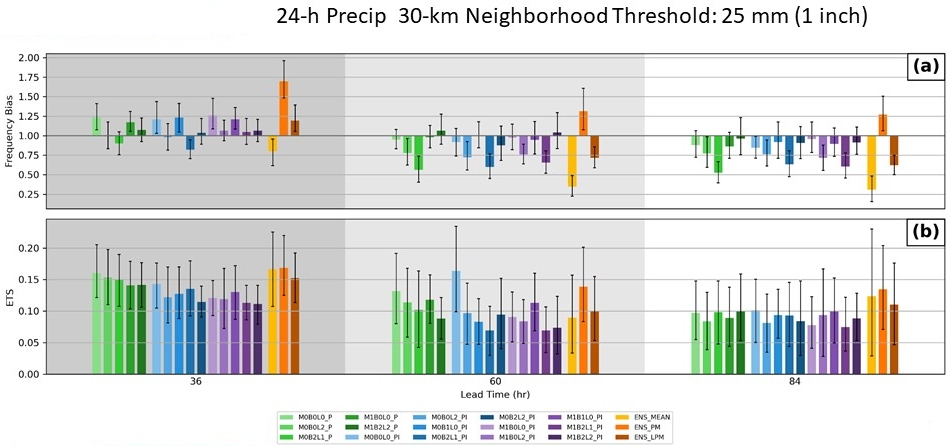
 - Indicates paper has been withdrawn from meeting
 - Indicates an Award Winner