
Sunday, 12 January 2025
Hall C (New Orleans Ernest N. Morial Convention Center)
Handout (4.8 MB) Handout (7.0 MB)
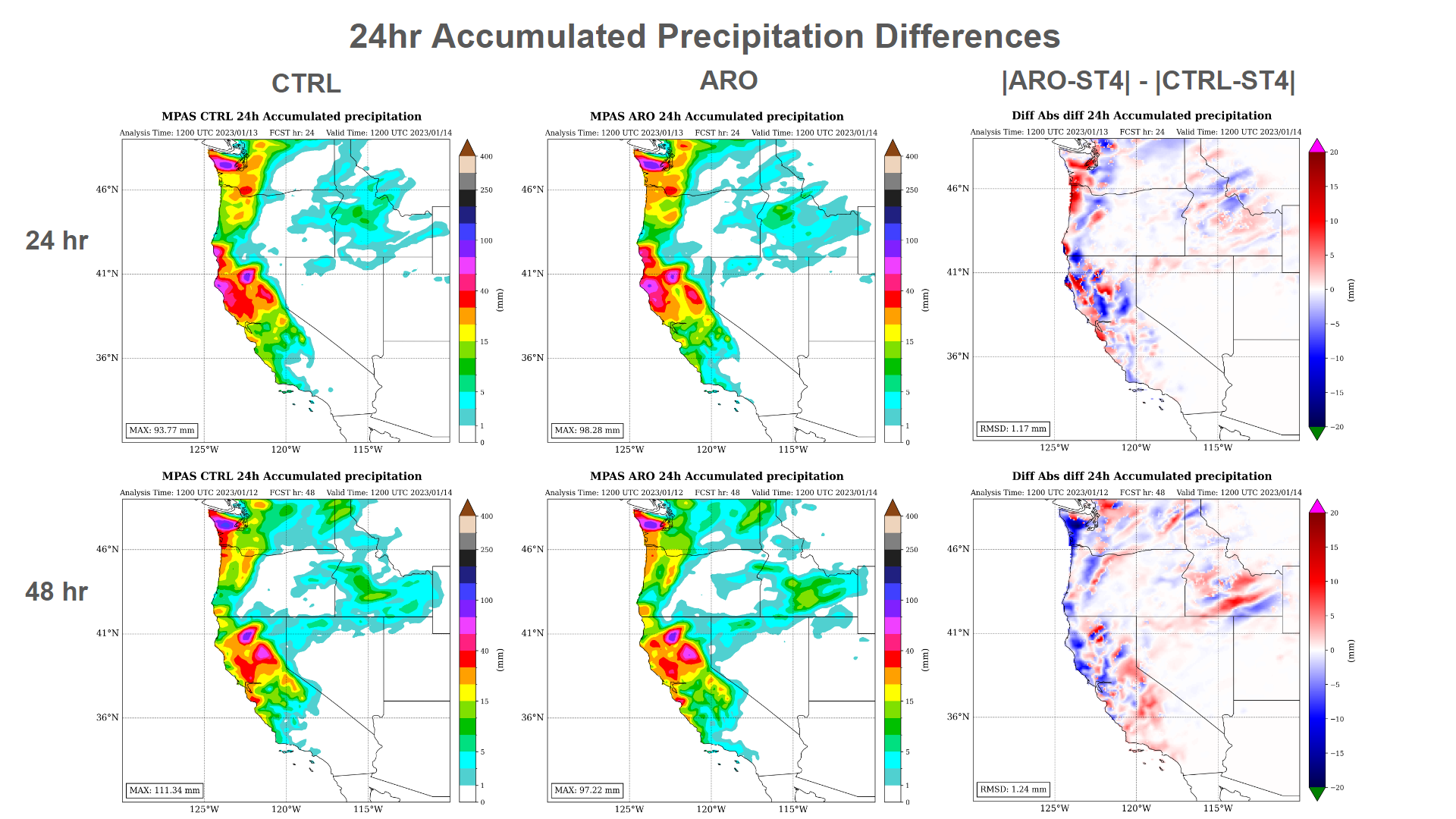
Atmospheric rivers (ARs) bring intense and prolonged periods of winter precipitation to the US west coast, resulting in 84% of flood damages to the region and $1 billion in damages every year. Therefore, improving AR forecasts is essential for better prediction of where they may land and their precipitation intensity. Previously, AR’s precipitation forecasts have been improved by using observations from dropsondes, buoys, and more recently, refractivity profiles from the Global Satellite Navigation System airborne radio occultations (ARO), during AR Recon campaigns. In this project, we investigate whether these forecasts can be enhanced even more by utilizing a more raw product from ARO, the bending angles. To determine these potential improvements, we study an unprecedented 11-flight sequence of ARO data collection between 6-17 January 2023. Two numerical experiments are analyzed, one control with no ARO bending angles and one assimilating this dataset, using the Model for Prediction Across Scales – Atmosphere (MPAS-A) coupled with the Joint Effort for Data assimilation Integration (JEDI). The MPAS forecasts are verified against vertically integrated water vapor transport and mean sea level pressure from ERA5 Reanalysis as well as U.S. Stage-IV precipitation data over the West Coast. Using contingency tables and categorical statistics we see improvements in forecast accuracy using ARO bending angles compared to the control forecasts. This phenomenon is observed particularly well at the 00 UTC analysis time where there is a larger direct impact from the ARO observations being assimilated, the indirect impact at other times shows more mixed results, yet benefits are still present over the West Coast. Additionally, ARO demonstrates better forecast skills for the 24- and 48-hour forecast ranges and for heavier thresholds of precipitation (⪭25mm/hr). The results of this work could have future global implications for weather forecasting around the world. With the knowledge that ARO bending angles successfully improve precipitation forecasts, the instrumentation could be implemented on commercial aircraft across the globe leading to significant improvement in weather forecasting and predicting extreme precipitation events.
 - Indicates paper has been withdrawn from meeting
 - Indicates an Award Winner