
The Hazardous Weather Testbed (HWT) Watch-to-Warning Experiment was designed to investigate how forecasters communicate with each other, their partners, and the public during this time period. Across six weeks in 2023 and 2024, 18 WFO forecasters and 11 SPC forecasters participated in multiple archive events ranging in complexity. Several novel concepts were evaluated in these recent HWT experiments, from shorter-fused adaptable watches focused on providing two hours of lead time through testing the feasibility of continuous forecaster generation of Probabilistic Hazard Information (PHI) plumes and Threats-in-Motion (TIM) warnings simultaneously. Storm-based PHI was used to fill gaps between the watch and warnings and provide information for storms that may not meet full warning criteria. Meanwhile, Threats-In-Motion (TIM) moved the deterministic warning polygons automatically using the storm motion, providing equitable lead time for downstream users.
Prototype cloud-based tools and platforms were used to create and distribute products and algorithms across forecasters from different organizations. To ease forecaster workflow, multiple machine learning algorithms were used to provide a first guess of probabilities of tornadoes, hail, and wind. Specifically, a new blended machine learning algorithm that combined both storm-scale observational data with guidance from the NSSL Warn-on-Forecast system (WoFS) was heavily used by forecasters to create both mesoscale and local discussions ahead of and between watches and warnings.
Communications with partners including Emergency Managers using NWS chat via Slack and public facing social media were also investigated, with exciting new communications templates arising from the experiment. Overall, these experiments have demonstrated the value in SPC-WFO communication and a means for delivering seamless, internally-consistent watch-to-warning products to the public from the SPC and WFOs. Feedback gathered during the experiment has provided inspiration and direction for further development of storm-based probabilistic hazard research, as well as guidance for which concepts might successfully progress towards operations. This presentation will focus on both results from the most recent experiments as well as discuss the potential impacts for future communication of the risk associated with individual severe storms hazards within the watch-to-warning period. 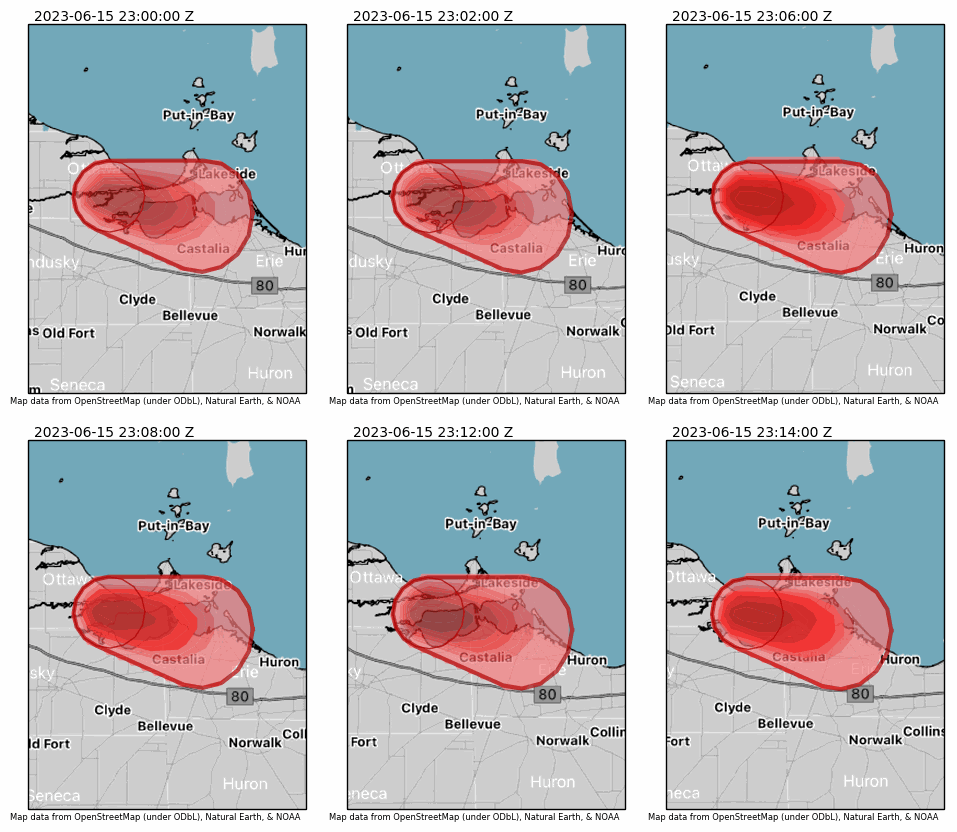
 - Indicates paper has been withdrawn from meeting
 - Indicates an Award Winner