
Tuesday, 14 January 2025: 9:00 AM
243 (New Orleans Ernest N. Morial Convention Center)
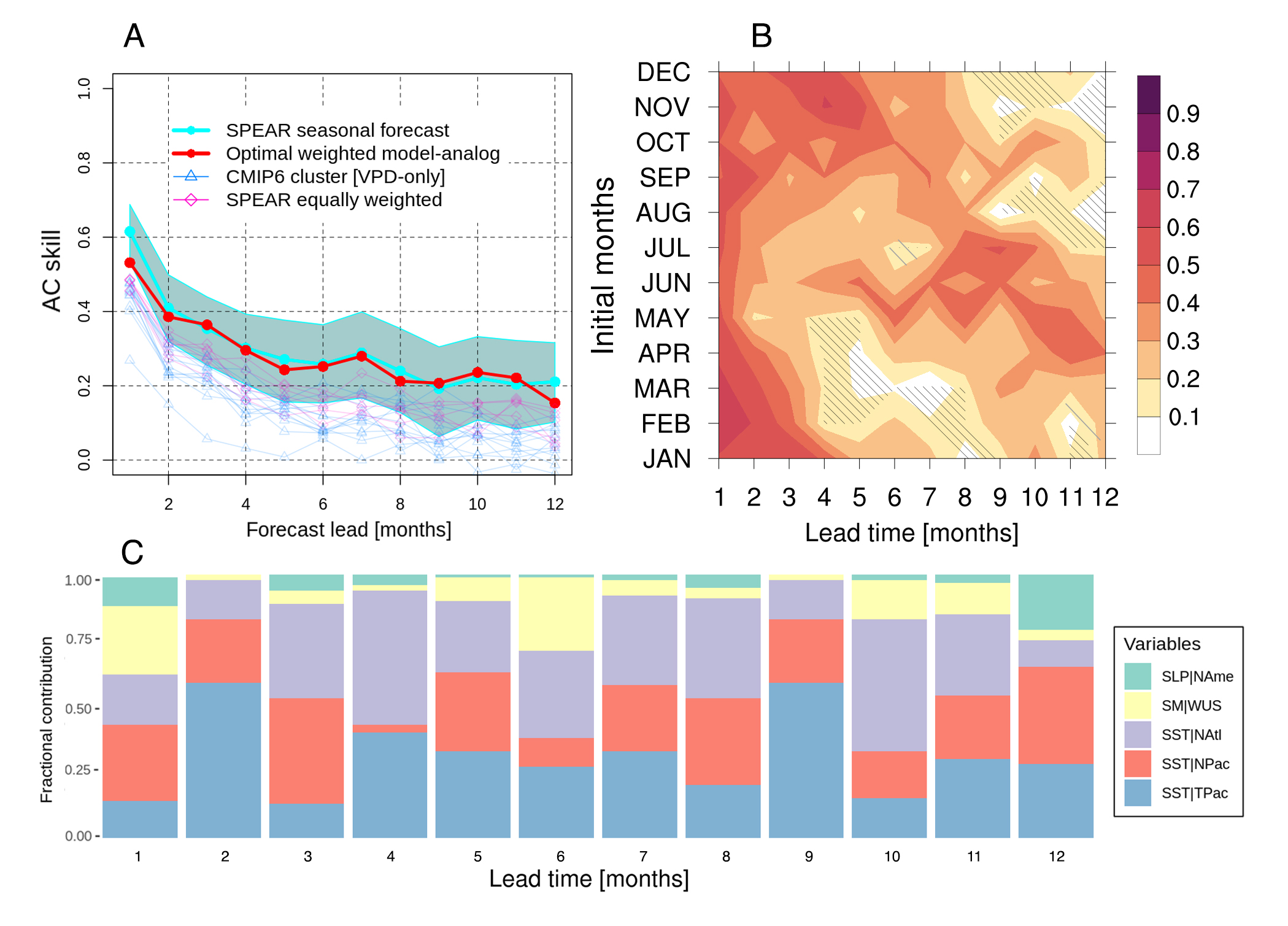
Atmospheric vapor pressure deficit (VPD), which measures the difference between saturation vapor pressure and actual vapor pressure, is closely related to fire activity in the western United States (US). Here, we compare the forecast skill of monthly VPD variability using a state-of-the-art forecasting system against two benchmarks: persistence and model-analog . For model-analog forecasts, we select analog states resembling the observed initial conditions from the model space, and the subsequent evolution of those initial model-analogs yields forecast ensembles. Our results show that numerical predictions generally outperform persistence forecasts in predicting VPD variability in the western US. Using a bootstrapping method, we develop a weighted model-analog mask to quantify the relative importance of each predictor in contributing to VPD predictability. We show that while the predictability based on VPD alone is limited, sea surface temperature emerges as a critical source of predictability, providing model-analog forecast skill of VPD comparable to that of the numerical model. VPD forecast skill also exhibits strong seasonality. Despite of having lower forecast skill when targeting summer and fall seasons, the higher skill tends to reemerge in the following winter and spring seasons.
 - Indicates paper has been withdrawn from meeting
 - Indicates an Award Winner