
Our study period is divided into two distinct temporal segments: mid-century (2036-2065) and future (2071-2100). Results indicate good model performance, albeit with some biases. Pearson correlation coefficients (R) were 0.84 for the LRS and 0.85 for the annual cycle, suggesting that the CMIP6 models capture approximately 72% of the variance in observed SSTs. Furthermore, a root mean square error (RMSE) value of 0.17 indicates that, on average, the CMIP6 ensemble mean predictions deviate from observed SSTs by 0.17°C. These statistical evaluations imply that the climate models effectively simulate the overall trends and variability of SSTs in this region with good accuracy. Projected spatial results for the mid-century and future LRS show the highest SST increases concentrated in the Caribbean Sea and Gulf of Mexico. Climate change projections highlight significant warming in these areas and parts of the western Atlantic Ocean, with temperature decreases towards the east. Findings, as illustrated in Figure 1, suggest that climate models project an overall increase in SSTs in the region during the LRS by the mid-21st century, with an exponential increase in SSTs in the future under each SSP scenario compared to the historical period. The Caribbean Sea and Gulf of Mexico are expected to experience the most substantial warming, potentially impacting various aspects of regional climate, including rainfall patterns, hurricane intensity, and marine ecosystems. By providing accurate SST projections, this research supports efficient adaptation and mitigation efforts addressing climate change impacts. Understanding how warming SSTs affect marine ecosystems and human life is crucial, particularly in assessing potential links to heat stress, marine heatwaves (MHWs), and hurricanes. This work contributes to this goal in sensitive regions with high number of vulnerable populations.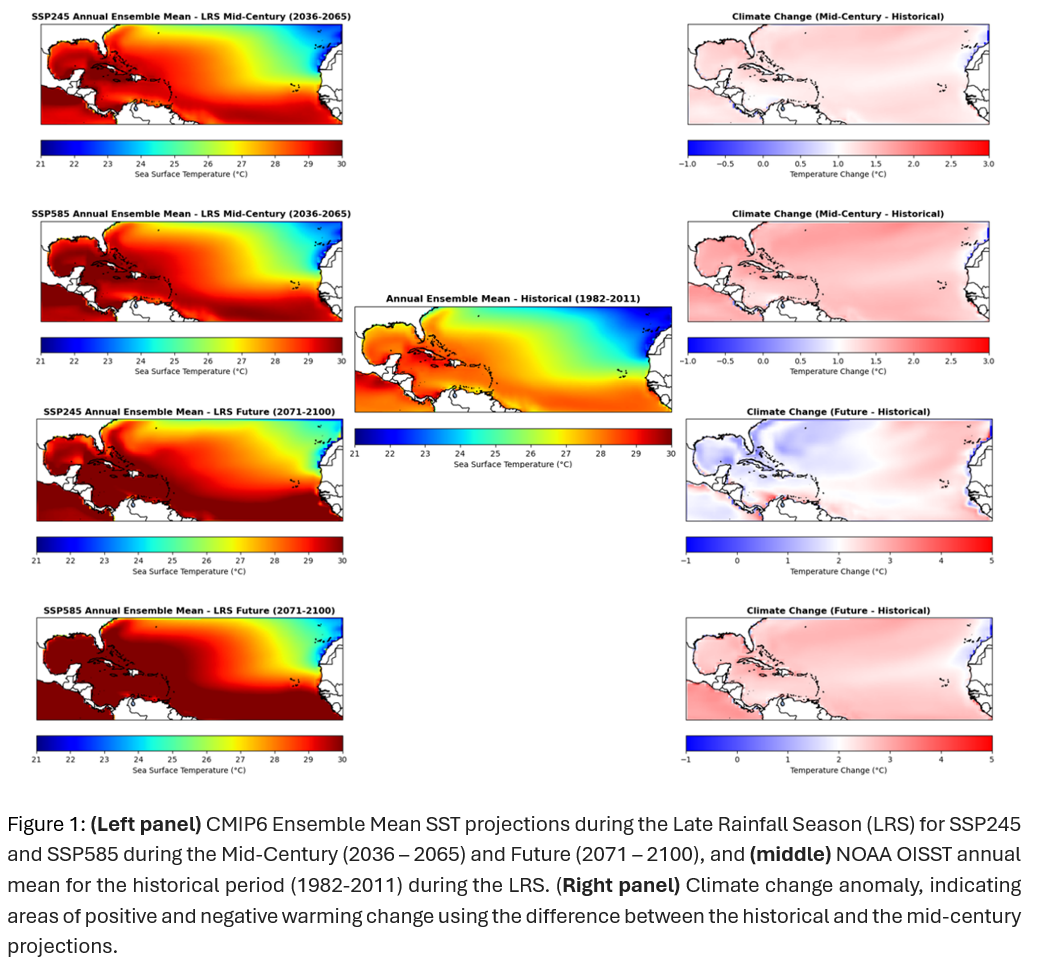
 - Indicates paper has been withdrawn from meeting
 - Indicates an Award Winner